Home > Animal Kingdom > Creepy Crawlies > Giant Insects
World of Insect Giants
Earth Invaded by Giant Insects!
The most successful and plentiful
life form on earth is without a doubt - insects. There are over
1 million known species of insects that have been identified,
with some scientists estimating that as many as 10 million species
may exist. That's species (types) of insects, each species has
uncounted numbers of actual specimens alive at any given time.
It seems there are as many insects on this planet as there are
stars in the universe. And it seems that nature has a fondness
for a certain kind of insect - beetles. Beetles account for the
vast majority of insects species. In fact, one out of every four
animals is a beetle!
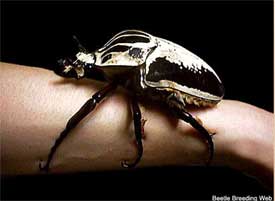 They come in an astonishing
variety of sizes, colors, and shapes. The world record holder
for the heaviest insect is a beetle - the
Goliath beetle (pictured at right). The Goliath beetle
can grow up to 4.5 inches (11cm) long. You can really get a sense
of how large this beetle is by looking closely at the picture
- this Goliath is crawling on a grown man's forearm. It's natural
to be creeped out by such a big bug, but Goliath beetles are harmless
to humans. Goliath beetles belong to the scarab family. They are
scavengers eating rotting vegetable matter that falls on the jungle
floors where they make their homes, or even eating and collecting
animal dung (feces). They are Mother Nature's janitors, processing
the waste
materials of plants and animals. They're really quite efficient,
thriving on what few creatures would consider a food supply. There
are several other species of beetle that rival the monster size
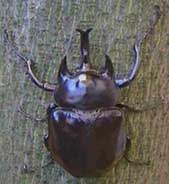
of the great Goliath beetles. Coming a close second is the Acteon
Beetle (pictured, below is Megasoma acteon, a type
of rhinoceros beetle (note the horns) that lives in the tropical
jungles of the Amazon region). It uses those horns to "joust" They come in an astonishing
variety of sizes, colors, and shapes. The world record holder
for the heaviest insect is a beetle - the
Goliath beetle (pictured at right). The Goliath beetle
can grow up to 4.5 inches (11cm) long. You can really get a sense
of how large this beetle is by looking closely at the picture
- this Goliath is crawling on a grown man's forearm. It's natural
to be creeped out by such a big bug, but Goliath beetles are harmless
to humans. Goliath beetles belong to the scarab family. They are
scavengers eating rotting vegetable matter that falls on the jungle
floors where they make their homes, or even eating and collecting
animal dung (feces). They are Mother Nature's janitors, processing
the waste
materials of plants and animals. They're really quite efficient,
thriving on what few creatures would consider a food supply. There
are several other species of beetle that rival the monster size
of the great Goliath beetles. Coming a close second is the Acteon
Beetle (pictured, below is Megasoma acteon, a type
of rhinoceros beetle (note the horns) that lives in the tropical
jungles of the Amazon region). It uses those horns to "joust"
 The Dinosaur Insect The Dinosaur Insect
On the island of New Zealand, there is a grasshopper-like species
of insect that is found nowhere else on earth. New Zealanders
have dubbed it the weta, which is a native Maori "god of
bad looks". It's easy to see why anyone would call this insect
a bad-looking bug. Most People are repulsed at the sight of these
bulky, slow-moving creatures. Most people don't feel sympathy
for these endangered creatures, but they do need protecting. Europeans
who came to Australia and New Zealand brought rats and cats with
them.The slow and ungainly wetas have been around on the island
since the dinosaurs roamed and have evolved and survived in an
ecosystem that had no predators for the weta. Until the rats came
to the island. The rat population on the island has burgeoned
into a real problem for many of the native species who are unaccustomed
to its presence, and has put a serious dent in the native weta
population. Quite simply, rats love to hunt and eat wetas.
The photo below is of a rare
tusked weta, that grows up to two inches (5cm) long. The Giant
Weta can grow to over three inches (8 cm) long 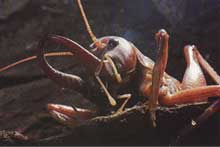 and
weigh as much as 1.5 ounces (40 grams). Giant wetas can hop up
to 2 feet (60cm) at a time. They are nocturnal creatures, venturing
out of the safety of their holes and caves only after dark. Some
Giant wetas live in trees, and others live in caves. Giant wetas
are very long-lived for insects, the adults can live for over
a year. Just like their cousins, grasshoppers and crickets, weta
are able to "sing" (formally called stridulation)
by rubbing their leg parts together, or against their abdomens. and
weigh as much as 1.5 ounces (40 grams). Giant wetas can hop up
to 2 feet (60cm) at a time. They are nocturnal creatures, venturing
out of the safety of their holes and caves only after dark. Some
Giant wetas live in trees, and others live in caves. Giant wetas
are very long-lived for insects, the adults can live for over
a year. Just like their cousins, grasshoppers and crickets, weta
are able to "sing" (formally called stridulation)
by rubbing their leg parts together, or against their abdomens.
What is the largest moth in the world? ->
|
Get Your Degree!
Find schools and get information on the program that’s right for you.
Powered by Campus Explorer
|

 Extreme Science is a registered trademark. All rights reserved.