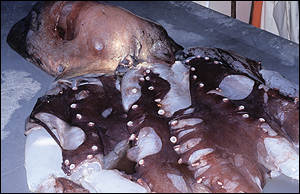
Scientists have known about
the existence of a species of squid that is reported to be significantly
larger than the giant squid, but had not seen or collected a complete
specimen of the Colossal squid, named Mesonychoteuthis hamiltoni.
This species of squid was first identified in 1925 after two arms were
recovered from a sperm whale's stomach. In 2003 a virtually intact specimen
of this never-before-seen squid had been brought up in Antarctic waters
from an estimated depth of 2,000 to 2,200 meters. And recently, in February
of 2007 a live colossal squid was brought to the surface in Antarctic
waters by a New Zealand fishing boat. This time video was taken and
the squid was captured for scientific study. This enormous squid, which
was determined to be a male of the species, was 10 meters (32.8 feet),
and weighed 1,089 pounds, making it the largest squid (the largest invertebrate)
ever captured. What was even more astonishing is that, from what scientists
know about squid species in general, there is great sexual
dimorphism in squids, with females being significantly
larger than the males. If that holds true for the Colossal squid, this
male specimen that was captured could very well be dwarfed by a much
larger female of the species.
Colossal squid are known to inhabit the abyssal
depths of the ocean primarily in the Southern Ocean that circumnavigates
Antarctica. Evidence of their existence has been obtained from the
stomachs of the largest predatory carnivore in the sea - the mighty
sperm whale. Many Sperm whales carry scars on their backs
believed to be caused by the hooks of Colossal Squid. One of the significant
morphological differences between the giant squid and the colossal
squid is the existence of swiveling hooks on each of the sucker discs
in the clubs at the ends of the colossal squids' feeding tentacles.
The giant squid merely have a circular, serrated row of 'teeth' inside
each of their sucker discs. Either way, both of these species of squid
make for formidable and terrifying predators of the deep. Colossal
Squid are a major prey item for Antarctic sperm whales feeding in
the Southern Ocean; 14% of the squid beaks found in the stomachs of
these sperm whales are those of the Colossal Squid, which indicates
that Colossal Squid make up 77% of the prey consumed by these whales.
Not only are the Colossal squid the largest
invertebrates in the world, they have the largest eyes of any living
on earth - even bigger than the blue
whale. Much of the evidence of these squids that has
been gathered from the stomachs of sperm whales have been the enormous
beaks of the colossal squid.
Another species of deep ocean
creature that has been world famous for centuries has just recently
come into the spotlight. Ancient stories from men who traveled the seas
exploring the world told of giant monsters of the deep that rivaled
the size of the ship. These stories were ridiculed as nonsense recently
as humans began to explore the ocean depths because no such creature
had ever been spotted.
However, scientists have slowly
been piecing together evidence of the elusive giants and recently began
finding some very large specimens washed up on shore. The stomach contents
of sperm whales have revealed body parts of these huge creatures and
sucker marks on some
whales'
skin stand as evidence of goliath battles in the deep between the whale
and the giant squid. The largest squid found so far had an overall length
of about 32 feet, including the two long feeding tentacles. There may
be other squids out there even larger. Maybe YOU could be a Teuthologist
(a scientist who studies squids) and be the first to discover a live
specimen of Architeuthis dux!
In October of 2001 the remains of an enormous
octopus were netted by the research ship of New Zealand's National Institute
of Water and Atmospheric Research (NIWA) in the waters off New Zealand.
At first, Marine biologist Dr.
Steve O'Shea dismissed the specimen as another carcass of a giant squid
and it was put into storage in a freezer. But later on, when he cleaned
out his
freezer and began to carefully examine the specimen he realized that
it was not a giant squid, but a huge specimen of octopus, a species
not native to the South Pacific. Dr. O'Shea has preliminarily identified
the species as belonging to Haliphron atlanticus, but qualifies
that as only an educated guess. Further studies will be necessary to
confirm the species of giant. He conservatively estimated the full size
of the living specimen to be roughly 13 ft/4 meters long, or up to 26
ft/8m across.
Read about the Deepest
Place in the Ocean
See the World Record
Index to see all the records featured on Extreme Science.